historY

The estate was founded back in 1849 by FRANZ PETER BUHL (1809-1862) and came about as part of the distribution of the original Jordan estate into three smaller estates. Wine connoisseurs were familiar with the name BUHL long before that, as he, the son-in-law of the wealthy Jordan family, had inherited large sections of the family’s property following the death of his father-in-law Peter Heinrich Jordan, whose estate he carried on under the name PETER HEINRICH JORDAN ERBEN and even then was producing some excellent Riesling wines.

In 1842 FELIX MENDELSOHN BARTHOLDY wrote to a friend after a visit to REICHSRAT VON BUHL: "But if you haven’t been to the Buhl estate, you don’t know what Forster Riesling is"
As a member of the Bavarian Parliament (1855 until his death) FRANZ PETER BUHL was a vociferous spokesman for the interests of German winegrowers.

Under the management of his son, FRANZ ARMAND BUHL (1837-1896), VON BUHL became even more successful and even achieved international fame for his Palatinate Riesling wines by attending congresses and international exhibitions. Awards like

• The Gold Medal Paris 1867
• The Grande Medaille of Philadelphia 1876
• Grand Prix Paris 1900
• Grand Prix St. Louis 1904
• Grand Prix Brussels 1910

are testament to this highly successful era at the estate, which saw BUHL wines become some of the most expensive wines in the world. Even at the official opening of the Suez Canal in 1869, it was VON BUHL Riesling wine in the glasses raised for the toast

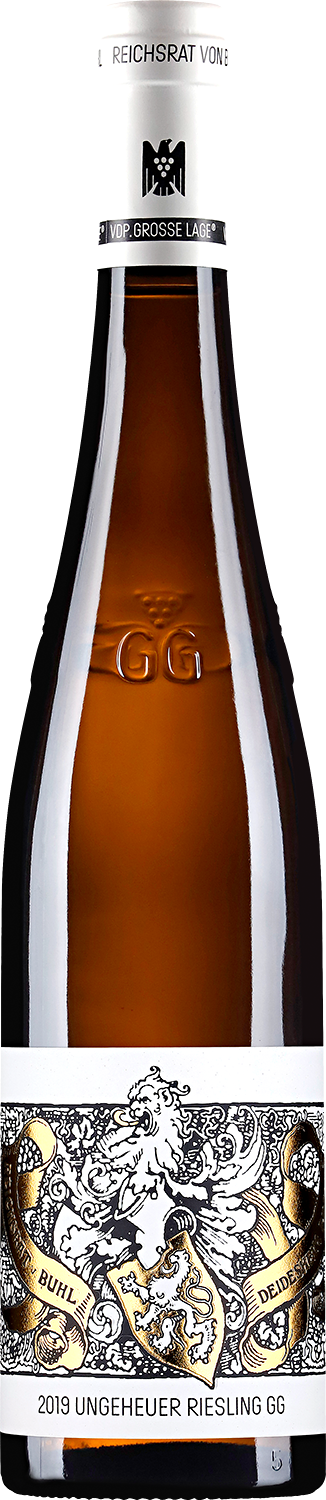
The Imperial Chancellor BISMARCK, himself a great lover of BUHL wines (His famous quote "Dieses Ungeheuer schmeckt mir ungeheuer" this Ungeheuer tastes monstrously good, (Ungeheuer = monster) helped make the Forster Ungeheuer site world-famous), described Armand, the Vice-President of the German Reichstag, as "his personal friend and comrade in arms".

We owe a debt of gratitude to Armand, who as the leading expert and leading member of the Association of Winegrowers passed the law banning the import of foreign vines (1873), thereby warding off the danger of vine pest that had already wrought major havoc in German vineyards. He had more input than anyone else into the German Wine Law of 1892 that set the foundation for guaranteeing the quality of German wines. In 1883-89 King LUDWIG II gave him the title "Imperial Council of the Bavarian crown" for his huge contribution to German social legislation
Armand’s marriage to Juliane Schellhorn-Wallbillich, daughter of a very affluent winegrowing family from Forst, produced a son FRANZ EBERHARD BUHL (1867-1921). In 1909 the latter joined his parents’ legacy to the areas acquired by marriage to create one of the largest German wine estates in private ownership: total area approx. 200 hectares, land under vine approx. 100 hectares. He also incorporated the title of Imperial Council of the Bavarian Chamber bestowed on him in 1912, into the name of the estate. He made a further name for himself as the founder and president of the German Wine-growing Association that had dedicated itself to researching and maintaining the quality of German wines.

Upon his premature death in 1921, his widow FRIEDA PIPER VON BUHL took over the reins at the estate. Despite the fact that she had never before been involved in wine-growing, she managed (with the help of an outstanding cellar master) not only to maintain but even improve the high quality. This remarkable lady also played a significant role in ensuring that a pension was set up for orphans and widows of winegrower families in the Palatinate region.

She subsequently died in the year 1952, with no apparent heir to the family estate and in line with her deceased husband’s wishes, bequeathed the estate to his political friend, Imperial Council GEORG ENOCH VON UND ZU GUTTENBERG. After the latter’s death, the estate was taken over by his son KARL THEODOR VON UND ZU GUTTENBERG, a member of the German Parliament and Under-Secretary of State. In 1952 the estate passed to his son, the famous conductor ENOCH VON UND ZU GUTTENBERG. The estate was scaled down more and more due to economic difficulties in its operation, until the entire property was left with only around 52 hectares of land under vine, albeit including the best vineyard sites in Deidesheim and Forst, such as Forster Kirchenstück, Pechstein, Jesuitengarten, Freundstück and the Deidesheim sites Leinhöhle, Herrgottsacker and Paradiesgarten.